Banbury’s Oldest Surviving Structure
Discover the remarkable medieval Cherwell Bridge: the hidden 13th-century structure beneath later railway engineering in Banbury.
When people think of Banbury’s history, they often picture the Market Place, the Cross, or the long-lost Banbury Castle. Yet one of the town’s most remarkable historic treasures is largely hidden from view. Tucked beneath later Victorian engineering lies what is arguably Banbury’s oldest surviving structure: the Medieval Cherwell Bridge.
A bridge that helped build a town
The story of the Cherwell Bridge is inseparable from the story of Banbury itself. During the Middle Ages, Banbury was under the control of the powerful Bishops of Lincoln, who transformed the settlement into an important market town. The River Cherwell and its extensive flood plain formed a significant obstacle for travellers, traders, and livestock moving east and west across the region.
To overcome this challenge, the Bishop of Lincoln commissioned a substantial stone bridge in the 13th century. Rather than simply crossing the river itself, the structure was designed to carry the road safely over the wider flood plain, ensuring reliable access to Banbury even during periods of flooding.
This was no ordinary bridge. Historical accounts suggest that it originally stretched for around 258 feet and contained seven pointed stone arches, making it a considerable feat of medieval engineering. The bridge elevated the road above the wet ground and marshy flood plain, creating a dependable route into the growing town.
A vital medieval crossing
For centuries, the bridge served as one of the principal gateways from the Saxon settlement of Grimsbury into Banbury. The crossing formed part of an ancient east-west route used by merchants, farmers, pilgrims and travellers long before the modern road network existed.
As Banbury’s importance as a market town increased, so too did the significance of the bridge. It enabled goods, livestock and people to move more easily across the Cherwell Valley, helping to support trade and economic growth. The investment by the Bishops of Lincoln was not simply an act of public works; it was a strategic decision that strengthened Saxon-founded Banbury’s role as a regional commercial centre.
The bridge was so important that local benefactors regularly left money for its repair and maintenance. Its upkeep was regarded as essential to the prosperity of the town.
Surviving the railway age
The greatest threat to the bridge came not from medieval warfare or natural disasters, but from the arrival of the railways in the nineteenth century.
In 1850, the construction of Brunel’s Great Western Railway dramatically altered the landscape around the Cherwell. The river was diverted, new embankments were built and much of the medieval bridge was demolished to make way for modern infrastructure. Five of the original seven arches disappeared.
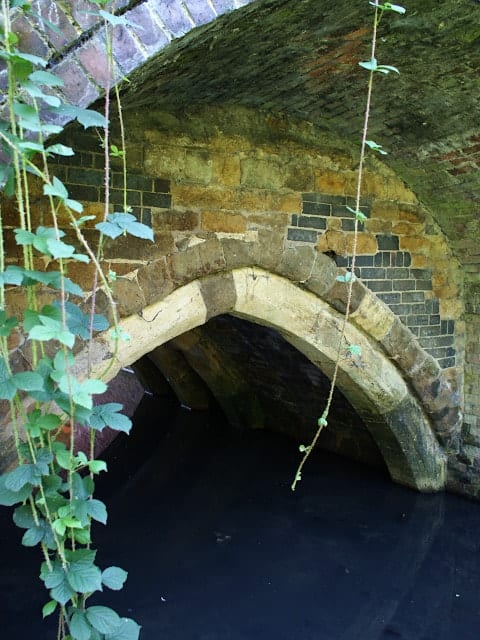
Remarkably, two arches survived. Rather than being destroyed, they became hidden beneath later Victorian brickwork and railway engineering. Today, these surviving sections remain concealed beneath the modern bridge structure near Bridge Street Park, largely unnoticed by the thousands of people who pass over them every week.
Banbury’s oldest building?
Banbury contains sites with older origins, but very few above-ground structures from the medieval period remain intact. Banbury Castle has long since vanished, and many of the town’s historic buildings have been substantially altered over the centuries.
For that reason, the surviving arches of the Medieval Cherwell Bridge have a strong claim to be Banbury’s oldest standing structure. More than seven hundred years after they were built, they continue to stand as a tangible link to the town’s medieval past.
These ancient stones witnessed the growth of Banbury from a bishop’s planned market town into the thriving community we know today. They supported generations of travellers, traders and townspeople while surviving floods, changing transport systems and the arrival of the railway age.
A hidden gem worth celebrating
The Medieval Cherwell Bridge is one of Banbury’s overlooked historical treasures. Hidden beneath Victorian brickwork and modern infrastructure, it is easy to pass by without realising its significance.
Yet these surviving arches tell an extraordinary story of medieval ambition, engineering skill and civic investment. They remind us that Banbury’s success was built not only on markets and commerce, but also on the infrastructure that connected people, places and opportunities.
As Banbury continues to grow and evolve, the hidden remains of the Cherwell Bridge deserve greater recognition. They are more than fragments of an old crossing. They are the oldest surviving structure in Banbury, in Grimsbury & Castle Division, and a remarkable legacy from the town’s medieval past.
Explore Topics
Written by
Paul-Austin Sargent
County Councillor for Banbury Grimsbury & Castle, Oxfordshire County Council.